Top Stainless Steel Ball Valve Manufacturers Worldwide

Choosing among the top stainless steel ball valve manufacturers worldwide requires more than comparing prices or catalog size. Buyers must examine pressure ratings, temperature limits, connection standards, seat materials, and documented testing. A valve may look robust on a screen, yet its performance depends on details such as the ball finish, stem design, and seal selection. Small details matter.

Quality-management expert W. Edwards Deming is widely associated with the principle, “Quality is everyone’s responsibility.” That idea fits valve manufacturing: reliable products depend on controlled processes, skilled assembly, and consistent inspection—not polished brochures alone. This guide surveys manufacturers across major industrial markets and highlights the evidence buyers can request, including material traceability, pressure-test records, and clear product data. It also considers service support and customization, which can matter when a valve must fit an existing line.

No single manufacturer is best for every application. Stainless steel ball valves used in food processing may face different cleaning demands than valves installed in marine or chemical service. The comparison should therefore begin with operating conditions, not brand claims. Rankings can change as product ranges and quality systems evolve. Treat this overview as a starting point, then confirm specifications directly with each supplier. That extra check is worth doing.
Top Stainless Steel Ball Valve Manufacturers Worldwide

What Stainless Steel Ball Valves Are and How They Work

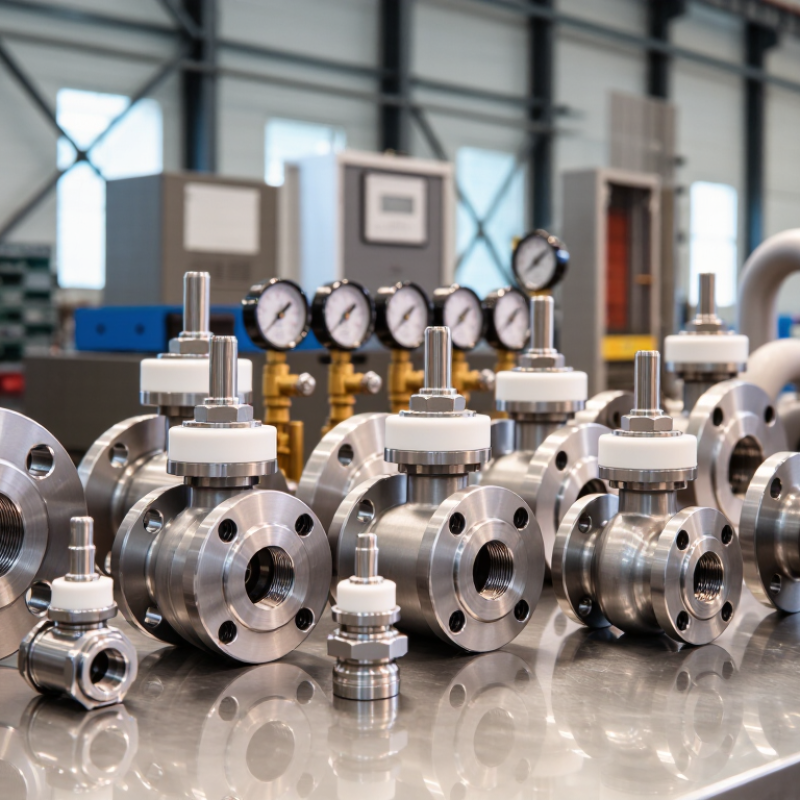
A stainless steel ball valve controls flow with a bored sphere held between seats. Turn the handle 90 degrees, and the bore either aligns with the pipe or blocks it. Simple motion. In a full-port design, the opening closely matches the pipe’s inside diameter, limiting flow restriction. Reduced-port valves use a smaller opening, which can create a greater pressure drop. The American Petroleum Institute’s API 608 specification covers metal ball valves for common industrial piping applications; it is a useful reference when comparing design and testing requirements.

Material selection matters as much as the mechanism. Many cast stainless valves use CF8M, a molybdenum-bearing grade often selected for improved resistance to certain corrosive environments. It is not immune to corrosion: fluid chemistry, temperature, and stagnant pockets can change performance. The World Stainless Association reported 58.4 million tonnes of global stainless-steel crude production in 2023, showing the material’s broad industrial use, not proving any valve’s service life. Operators should verify pressure and temperature ratings, seat compatibility, and end connections against the actual system. A dry handle can mislead. Check for leakage under operating conditions, too, since installation stress or seat wear may not show during a quick visual inspection.

Key Valve Types, Materials, and Performance Standards

Stainless steel ball valves are selected by flow path, pressure, temperature, and service fluid—not by alloy name alone. Full-port designs reduce restriction, while reduced-port bodies save space and cost. Floating-ball valves suit many moderate-pressure duties; trunnion-mounted designs support larger sizes and higher operating loads. Details matter.

Body materials commonly include 304 or 316 stainless steel. Grade 316 offers better resistance to many chloride environments, but it is not immune to pitting. Seat choice matters too: PTFE suits many clean-fluid applications, while reinforced polymers may handle greater pressure or temperature. Compatibility charts help, yet concentration and operating temperature can change the answer.

Buyers should compare pressure-temperature limits and test documentation. ASME B16.34 addresses valve design requirements, while API 598 covers inspection and pressure testing; neither replaces application-specific verification. ISO 5211 defines actuator mounting interfaces. Ask whether the valve was tested in its supplied configuration, including seats and end connections. A catalog rating can mislead when the actual media, cycling frequency, or temperature differs from test conditions. Specifications sometimes leave uncomfortable gaps.

How to Evaluate Stainless Steel Ball Valve Manufacturers

How to Evaluate Stainless Steel Ball Valve Manufacturers

Evaluating a stainless steel ball valve manufacturer starts with the application, not the catalogue. Define the fluid, operating pressure, temperature range, and connection type before comparing quotations. Ask which stainless steel grade is used for the body, ball, and stem, and request material certificates linked to the supplied batch. Clear traceability matters. A polished surface alone cannot prove suitable metallurgy.

Review how the manufacturer controls machining and assembly. Ask for pressure-test procedures, inspection records, and acceptance criteria; then check whether they apply to the exact valve design you need. A sample can reveal rough edges, uneven handle movement, or poor seat alignment. These checks are useful, but one sample does not establish consistent production. Ask how inspection results are recorded across a full order.

Technical support is another practical measure. Can staff explain seat materials, seal limitations, and maintenance needs without making broad claims? Check whether drawings, operating instructions, and test documents are complete and consistent. Compare lead times with stated production capacity, and clarify how defects are handled. A very low price may reflect lean overhead, or missing quality controls; the quotation alone will not tell you. That uncertainty deserves a direct question.

Top Stainless Steel Ball Valve Manufacturers Worldwide — How to Evaluate Stainless Steel Ball Valve Manufacturers

Evaluation Dimension What to Check Evidence to Request How to Assess
Body and trim materials Confirm the specified stainless-steel grades for the body, ball, stem, and other wetted parts. Common cast grades include CF8 (roughly corresponding to 304 stainless steel) and CF8M (roughly corresponding to 316 stainless steel); exact equivalence depends on the applicable specification. Material certificates, purchase specifications, and traceability records for pressure-retaining parts. Check that material designations match the order and intended service. Do not assume that a “stainless steel” description alone confirms grade or suitability.
Pressure and temperature limits Review the pressure-temperature rating for the exact valve design, size, material, and end connection. Published rating tables, product drawings, and the applicable design specification. Verify ratings at the actual operating temperature; allowable pressure can vary with material and temperature.
Design standards Identify the standards used for design and construction. ASME B16.34 covers pressure-temperature ratings and design requirements for specified valve types; the applicable standard depends on the valve and application. Declaration of conformity, technical data sheet, and design documentation that identify the standard and edition. Check that the claimed standard applies to the selected valve type, size, pressure class, and connection.
Pressure testing Check shell and closure testing requirements. ISO 5208 and API 598 are examples of valve inspection and pressure-test standards. Test procedure, acceptance criteria, and lot- or serial-number-linked test reports. Confirm the test standard, test medium, duration, and acceptance criteria rather than relying on a general “100% tested” claim.
Fire-safe qualification Where fire exposure is a credible hazard, check whether the specific valve design has been qualified to a relevant fire-test standard, such as API 607 or API 6FA. Valid test documentation identifying the tested design, size range, materials, and configuration. Do not treat fire-safe construction claims as proof of qualification. Confirm that the tested configuration covers the valve being offered.
Leakage and seat design Determine whether the valve uses a soft or metal seat and identify the stated leakage criteria and test method. Seat-material details, pressure-test reports, and leakage acceptance limits. Match the seat design to the fluid, temperature, pressure, and required shutoff performance. “Zero leakage” should be supported by a defined test criterion.
End connections and dimensions Check whether the valve is supplied with the required threaded, flanged, socket-weld, or butt-weld ends and face-to-face dimensions. Dimensioned drawings and connection specifications, including the applicable standard where relevant. Compare drawings with the piping design and confirm that connection details, pressure class, and dimensions are consistent.
Actuation and mounting For automated valves, verify actuator sizing, operating torque, control requirements, and mounting-interface details. ISO 5211 specifies mounting dimensions for certain part-turn actuators. Torque data, actuator sizing calculations, interface drawings, and electrical or pneumatic specifications as applicable. Confirm that the actuator is sized for the valve’s operating conditions and that the interface matches the selected valve configuration.
Quality management and traceability Assess how the manufacturer controls incoming materials, production, inspection, and identification of finished valves. Quality-system documentation, inspection plans, and examples of material and product traceability records. Check that documentation can link the supplied valve to its materials, inspections, and test records. Verify any certification directly with its issuing body.
Customization and technical support Evaluate support for application review, drawings, special materials, accessories, and installation or maintenance questions. Sample technical submittals, response process, spare-parts information, and documented service arrangements. Use a representative technical inquiry to assess whether responses are specific, documented, and consistent with the requested operating conditions.
Delivery and lifecycle support Review quoted lead time, production capacity, spare-parts availability, warranty terms, and change-control practices. Written delivery commitments, warranty terms, spare-parts lists, and service contact procedures. Compare the complete supply and support offer, not only the initial purchase price. Confirm that critical spare parts can be identified and ordered.

Evaluation note: Standards, material grades, ratings, and certifications should be verified against the exact valve model and the latest applicable specifications. Suitability depends on the service conditions and project requirements.

Notable Stainless Steel Ball Valve Manufacturers Worldwide

Notable Stainless Steel Ball Valve Manufacturers Worldwide

Notable stainless steel ball valve manufacturers serve process plants, water systems, food production, and marine applications. Their strengths vary: some focus on forged bodies for compact, high-pressure service, while others offer cast designs in broad sizes. Manufacturers across Asia, Europe, and North America may differ in lead times, customization, and documentation. A well-finished valve matters, but so does consistent inspection. Ask how the maker verifies material grade, pressure performance, and seat sealing. A polished catalogue is not proof of reliable production.

Tips: Match the valve to the actual fluid, temperature, pressure, and cycle frequency. Request material certificates and relevant test records. Check whether dimensions, connection types, and actuator mounting fit your existing line. If a supplier cannot explain its inspection steps clearly, pause. That is not always a deal-breaker, but it deserves a closer look.

Compare manufacturers by traceability, machining quality, delivery support, and access to replacement seals. For stainless components, confirm whether the specified grade suits the environment; chloride exposure, for example, can change corrosion risks. Samples and technical drawings can reveal details that sales descriptions miss. One imperfect point: published specifications do not always show how consistently each production batch performs, so verify requirements before placing a large order.

Industries, Applications, and Selection Considerations

Stainless steel ball valves serve food processing, pharmaceutical, water treatment, marine, and chemical facilities. Their quarter-turn operation allows quick isolation, while stainless bodies can resist many corrosive environments. In a food line, for example, a valve may sit between a washdown area and a filling machine. Small details matter. Product contact, cleaning routines, and exposure to salt or chemicals all affect the choice.

Start by matching the valve body and internal components to the fluid, pressure, and operating temperature. Stainless steel alone does not guarantee compatibility; the specific grade and seat material matter. Check whether the process carries solids or thick liquids, since particles can collect around the ball or seat. For frequent cycling, consider the operating torque and whether manual or automated actuation fits the installation.

Connection type and maintenance access deserve attention too. A valve squeezed behind piping may be difficult to inspect, even if its specification looks right on paper. Request material and pressure-test documentation, and confirm that it matches the exact configuration being supplied. It is easy to focus on the body material and overlook the seals. Catalog data helps, but actual process conditions can be less tidy than a specification sheet suggests.