
Top 10 Types of Square Tube for Global Buyers
Choosing the right Square Tube is rarely a simple matter of comparing price per meter. Global buyers must examine material grade, manufacturing method, surface finish, dimensions, and applicable standards. A tube that looks identical on a warehouse floor may perform very differently in a bridge frame, solar rack, machine guard, or architectural project.
Dr. John E. Bringas, a recognized specialist in international steel standards, offers a useful principle: “A section is only useful when its dimensions, grade, and standard are understood together.” This perspective matters when comparing carbon steel, galvanized steel, stainless steel, aluminum, welded, seamless, cold-formed, and hot-formed options. Each type answers a different practical need.
Carbon steel Square Tube often suits structural frames and general fabrication. Galvanized tube adds protection where rain, condensation, or coastal air may accelerate corrosion. Stainless steel supports hygienic or highly corrosive environments. Aluminum reduces weight, though it may require careful strength and joining calculations. Welded tube can offer cost efficiency, while seamless tube may support demanding pressure or mechanical applications.
Small details matter. Wall thickness affects stiffness. Corner radius affects fit and appearance. Tolerance affects assembly. Surface quality affects painting and long-term maintenance.
Not every buyer needs the strongest tube. That choice can waste budget and increase weight. Yet selecting only by low cost can create expensive failures later. Standards are also easy to overlook, especially when suppliers use different naming systems. This guide compares ten practical Square Tube types, helping international buyers ask sharper questions, verify documents, and match each product with its real working conditions. Mistakes still happen. Good purchasing reduces their impact.
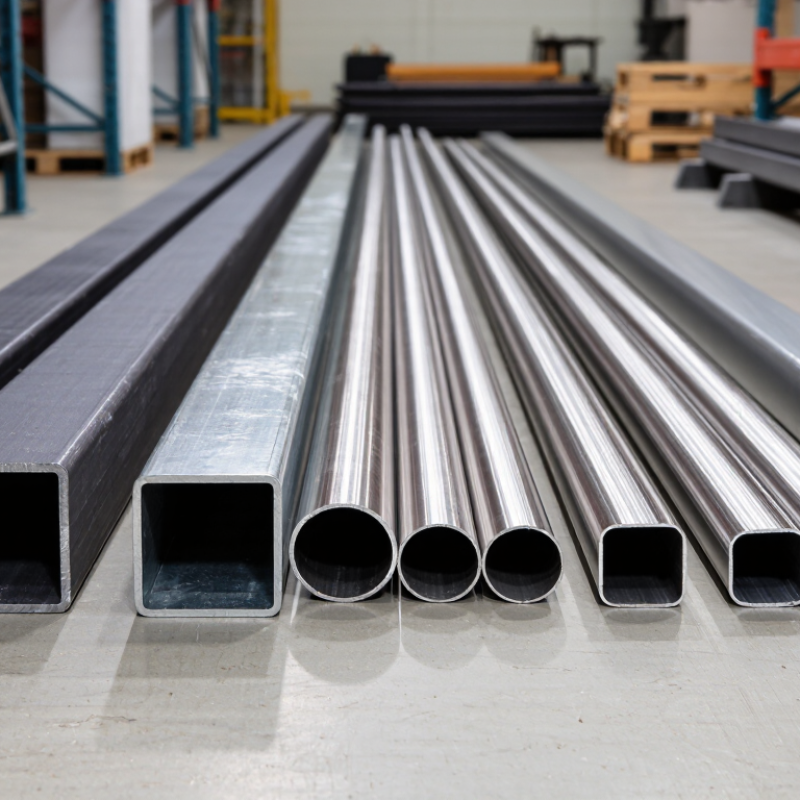
What Square Tubes Are and How They Are Classified
A square tube is a hollow steel section with four equal sides and a continuous wall. It carries loads while using less material than a solid bar. World Steel Association data recorded about 1.89 billion tonnes of crude steel production in 2023. This scale supports wide global availability, but quality still varies by mill and standard.
Global buyers commonly classify ten types: welded carbon steel, seamless carbon steel, galvanized, stainless welded, stainless seamless, hot-finished, cold-formed, structural, precision, and weathering steel tubes. These labels overlap. Manufacturing method, steel grade, surface treatment, dimensions, and end use usually determine the real classification. ASTM A500/A500M covers structural carbon tubing, while EN 10219 addresses cold-formed welded structural sections. ISO 657 also provides dimensional guidance. The boundary is not always neat.
Tips: Request the standard, grade, outside dimensions, wall thickness, corner radius, and coating mass. Ask for mill test certificates and independent inspection when projects are critical. Check whether “seamless” means truly seamless or only a marketing description. A 2024 industry review from the World Steel Association highlights continuing pressure for lower-carbon steel production, so buyers should also examine recycled content and production emissions. Specifications can look complete, yet one missing tolerance may cause costly fabrication problems.
Top 10 Types of Square Tube for Global Buyers - What Square Tubes Are and How They Are Classified
| No. | Square Tube Type | Primary Classification | Typical Material or Grade Family | Manufacturing or Surface Method | Common Size Range | Key Characteristics | Typical Global Applications | Common Reference Standards |
|---|---|---|---|---|---|---|---|---|
| 1 | Carbon Steel Hollow Structural Section | Material: carbon steel Use: structural | Low-carbon structural steel; grades commonly specified by regional standards such as S235, S275, ASTM A500 Grade B or equivalent | Usually electric-resistance welded (ERW); supplied with a mill finish | Common outside dimensions: approximately 20 × 20 mm to 500 × 500 mm; wall thickness depends on size and specification | High strength-to-weight ratio, good weldability, and efficient resistance to bending and compression | Building frames, machinery supports, bridges, racks, agricultural structures, and general fabrication | EN 10219, ASTM A500, JIS G3466, CSA G40.21, or equivalent project specification |
| 2 | Hot-Dip Galvanized Square Tube | Surface finish: zinc coated Use: corrosion-exposed structures | Carbon steel substrate with a zinc coating | Hot-dip galvanizing after fabrication or after tube production; coating weight varies by specification | Available in many structural sizes; common commercial sizes range from approximately 20 × 20 mm to 300 × 300 mm | Improved atmospheric corrosion resistance; zinc coating provides sacrificial protection to exposed steel | Outdoor frames, fencing, solar mounting structures, utility supports, agricultural buildings, and guardrails | ISO 1461, ASTM A123/A123M, EN 10346, or regional galvanizing requirements |
| 3 | Cold-Formed Square Tube | Manufacturing method: cold forming Section: hollow structural | Low-carbon or HSLA structural steel | Steel strip is roll-formed at room temperature and longitudinally welded | Commonly produced from small sections up to approximately 400 × 400 mm, subject to equipment and specification | Accurate dimensions, smooth external surfaces, and efficient production for repeatable structural sections | Light steel framing, furniture frames, equipment bases, shelving, and general construction | EN 10219, ASTM A500, JIS G3466, and comparable cold-formed hollow-section standards |
| 4 | Hot-Finished Square Tube | Manufacturing method: hot finishing Use: demanding structural service | Structural carbon steel or fine-grain structural steel; S355 is a common European grade family | Formed or finished at elevated temperature, which can help produce consistent mechanical properties and corner geometry | Often available in medium and large structural sections, including sizes above 300 × 300 mm | Suitable for heavily loaded structures; reduced residual-stress effects may be important in design and fabrication | Columns, heavy frames, industrial buildings, cranes, infrastructure, and load-bearing assemblies | EN 10210 and equivalent national structural hollow-section specifications |
| 5 | Stainless Steel Square Tube | Material: stainless steel Environment: corrosive or hygienic | Austenitic grades such as 304/304L and 316/316L; ferritic grades may also be used for selected applications | Welded or seamless; supplied with mill, brushed, polished, or satin finishes | Common outside dimensions range from approximately 6 × 6 mm to 300 × 300 mm, depending on grade and production route | Strong corrosion resistance, clean appearance, and low maintenance; 316/316L is generally preferred for chloride-rich environments | Food-processing equipment, architectural trim, handrails, marine fittings, chemical equipment, and clean-area structures | ASTM A554, ASTM A312, EN 10217-7, EN 10219-2, or applicable stainless-steel product standard |
| 6 | Aluminum Square Tube | Material: aluminum alloy Priority: low weight | 6061-T6, 6063-T5/T6, 6082-T6, or comparable wrought aluminum alloy families | Usually extruded; may be anodized, powder coated, painted, or supplied mill finish | Common outside dimensions range from approximately 10 × 10 mm to 250 × 250 mm; wall thickness varies by alloy and profile | Low density, good corrosion resistance, easy machining, and good appearance; lower elastic modulus than steel must be considered in design | Transport equipment, lightweight frames, solar systems, architectural assemblies, display systems, and machine guards | EN 755, EN 10219-2 for applicable aluminum sections, ASTM B221, or project-specific alloy requirements |
| 7 | Galvannealed Square Tube | Surface finish: zinc-iron coating Priority: paintability | Low-carbon steel coated with a zinc-iron alloy layer | Continuous galvannealing followed by tube forming, or galvannealing applied according to the product route | Commonly supplied in light to medium sections, approximately 15 × 15 mm to 200 × 200 mm | Uniform surface, good weldability, and strong adhesion for subsequent painting; coating performance depends on thickness and environment | Automotive components, appliance frames, indoor equipment, painted enclosures, and fabricated assemblies | EN 10346, ASTM A653/A653M, or equivalent coated-flat-steel requirements |
| 8 | Seamless Square Tube | Manufacturing method: seamless Priority: pressure or high-integrity service | Carbon steel, alloy steel, stainless steel, or other specified metal grades | Produced from a pierced billet and subsequently hot-finished or cold-drawn; no longitudinal weld seam | Commonly produced in smaller and medium sizes; exact limits depend on material, wall thickness, and process | No welded seam, consistent circumferential integrity, and suitability for specialized mechanical or pressure-related requirements | Hydraulic components, heat exchangers, precision machinery, high-integrity frames, and selected pressure applications | ASTM A519, ASTM A213, ASTM A269, EN 10216, or other material-specific seamless-tube standards |
| 9 | Precision Square Tube | Dimensional class: precision Priority: close tolerances | Cold-rolled carbon steel, stainless steel, aluminum, or other specified engineering alloys | Cold-drawn, cold-rolled, calibrated, or precision-welded; may receive annealing or stress-relief treatment | Usually supplied in small to medium sections, approximately 5 × 5 mm to 150 × 150 mm | Tighter dimensional tolerances, improved straightness, and smoother surfaces than standard general-purpose tubing | Automation equipment, telescoping assemblies, furniture, laboratory equipment, instruments, and machine components | EN 10305, ASTM A513, ASTM A554, ISO 2768 where applicable, and buyer-approved tolerance requirements |
| 10 | Decorative and Furniture Square Tube | End use: architectural or furniture Priority: appearance | Stainless steel, mild steel, aluminum, or pre-coated carbon steel | Welded or extruded; finishes may include brushed, polished, powder-coated, painted, or plated surfaces | Common outside dimensions range from approximately 6 × 6 mm to 100 × 100 mm | Selected for visible surfaces, consistent appearance, manageable weight, and ease of cutting and assembly; structural capacity must be verified separately | Furniture, railings, shopfitting, interior design, signage, partitions, displays, and architectural details | ASTM A554 for stainless decorative tubing, ASTM B221 for aluminum extrusions, EN product standards, and finish specifications |
Note: Size ranges are representative market ranges rather than universal limits. Actual availability, wall thickness, tolerances, mechanical properties, coating mass, and certification requirements depend on the material grade, manufacturing process, applicable standard, and buyer’s project specification.