
7 Tips for Buying a Front Motorcycle Spoke Wheel?
Choosing a Front Motorcycle Spoke Wheel is about more than appearance. The wheel must suit your motorcycle, riding conditions, and maintenance habits. A polished rim may catch your eye, but spoke condition, hub fit, rim dimensions, and build quality matter more on the road. Small details count.
In this guide, motorcycle wheel-building specialist Alex Rowan offers a practical rule: “Check fitment and spoke condition before you judge a wheel by its shine.” Use that advice as a starting point, not a substitute for your motorcycle’s specifications or a qualified mechanic’s inspection. A wheel that looks correct can still have the wrong dimensions or mounting details. Check the manufacturer’s requirements, inspect for corrosion and damage, and ask how the wheel was assembled and tested.
The seven tips ahead cover compatibility, materials, spoke quality, hub and rim condition, seller information, and ongoing care. Look closely at the spoke nipples and rim edges; that is where wear or damage may be easy to miss. Ask direct questions, and request clear photos when buying remotely. Not every listing will provide complete details. That should make you cautious, not rushed. A careful choice can improve confidence and help avoid costly fitment surprises, though no checklist replaces hands-on inspection.
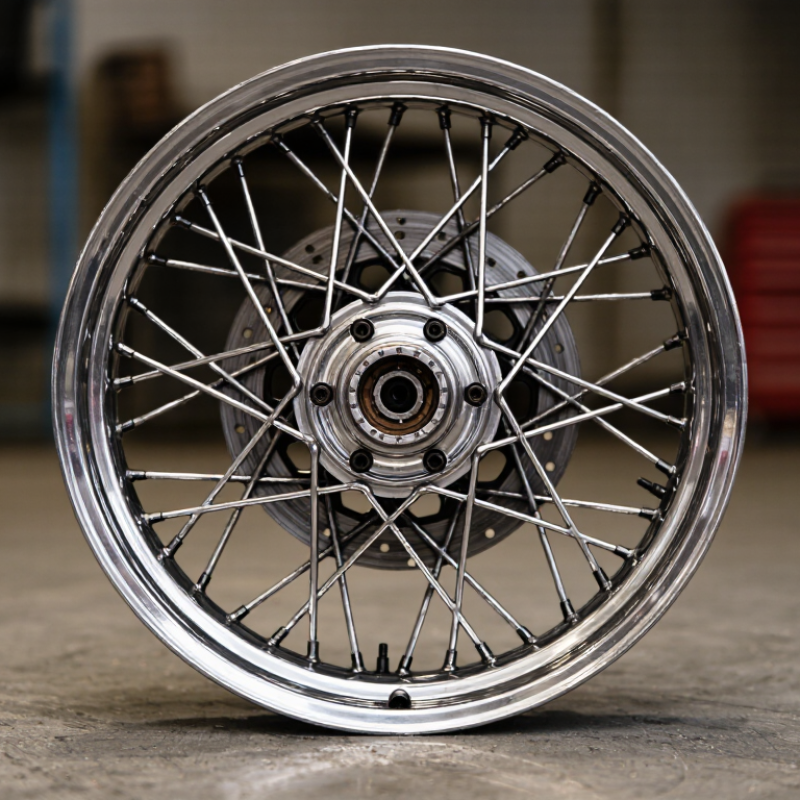
Start with OEM Fitment: Axle Diameter, Hub Width, Bearings, and Brake Offset
Tip 1: Start with the original equipment specifications for your motorcycle. Check axle diameter, hub width, and bearing dimensions before choosing a front spoke wheel. Bearing measurements include the inner diameter, outer diameter, and width. Small differences matter. Compare the figures with your service manual or a trusted parts reference, not just a seller’s fitment list. A wheel can look correct and still sit poorly on the axle.
Tip 2: Measure brake offset carefully. It is the distance from the hub’s reference face to the brake rotor mounting surface. Incorrect offset can leave the rotor misaligned with the caliper. Check rotor diameter and mounting pattern, too. After fitting, confirm that the wheel turns freely and the brake sits squarely. A quick visual check helps, but it cannot replace accurate measurement.
Tip 3: Verify spacer placement and fork clearance before riding. Use the specified axle and spacer arrangement, then tighten fasteners to the motorcycle’s service-manual values. Check that the tire clears the fork legs through a full rotation. I might be tempted to trust a close match, but “nearly fits” is a poor test. When measurements conflict, pause and confirm compatibility with a qualified motorcycle mechanic.
7 Tips for Buying a Front Motorcycle Spoke Wheel? - Start with OEM Fitment: Axle Diameter, Hub Width, Bearings, and Brake Offset
| Tip | What to Check | How to Verify | Why It Matters |
|---|---|---|---|
| 1. Confirm axle diameter first | Axle diameter and the front wheel’s bearing inner diameter (ID). | Check the motorcycle’s service information or measure the axle with a suitable caliper. The bearing ID must match the axle size specified for the application. | A wheel with the wrong axle or bearing ID will not install correctly. Do not assume that wheels with the same rim diameter share axle dimensions. |
| 2. Compare hub width and spacer arrangement | Hub width between the fork-side mounting faces, plus the position and length of any wheel spacers. | Compare the wheel and spacer stack with the original assembly. Measure from the same reference faces and follow the service manual’s assembly method. | Incorrect width or spacer placement can affect fork alignment, bearing loading, wheel centering, and brake-disc position. |
| 3. Match bearing dimensions and type | Bearing ID, outside diameter (OD), width, and specified bearing type. | Use the wheel or motorcycle parts documentation to confirm all bearing dimensions. Replace bearings with the specified type; matching only the ID is not enough. | The ID fits the axle, while the OD and width must suit the hub. An incorrect bearing may not seat properly or may fail under load. |
| 4. Check brake-disc offset and mounting | Rotor mounting pattern, bolt arrangement, rotor position, and offset from the wheel or hub centerline. | Compare the original and replacement wheel using the same reference points. Confirm the rotor sits in the correct plane within the caliper and that the specified rotor hardware is compatible. | Incorrect offset can misalign the rotor with the caliper. A matching bolt pattern alone does not confirm correct brake fitment. |
| 5. Verify rim diameter and width | Rim diameter, rim width, and compatibility with the tire size approved for the motorcycle. | Check the wheel markings and the motorcycle or tire maker’s fitment information. Confirm that the selected tire is approved for that rim width and wheel diameter. | Incorrect rim or tire sizing can change handling and clearance. Nominal tire size alone does not establish wheel compatibility. |
| 6. Check spoke and hub construction | Spoke count, lacing pattern, spoke condition, hub design, and suitability for the intended riding conditions. | Inspect for bent, cracked, loose, or corroded spokes and damage around the spoke holes. Confirm that the wheel is assembled for the motorcycle’s required front-wheel configuration. | Spokes distribute loads between the rim and hub. Damage, incorrect assembly, or unsuitable construction can compromise wheel strength and safety. |
| 7. Confirm clearance and final fitment | Clearance at the fork legs, brake caliper, fender, tire, and any speed-sensor components. | Use the correct axle, spacers, rotor, and tire for a trial installation. After assembly, verify free wheel rotation and follow the specified torque and inspection procedures. | A wheel that bolts on may still interfere with surrounding parts. Correct clearance and installation are essential before riding. |
Fitment note: Dimensions and tolerances vary by motorcycle model and year. Treat the original equipment specification or service manual as the reference; generic measurements are not a substitute for model-specific fitment verification.