
Choosing a Glass Chamfering Machine in 2026 requires more than comparing purchase prices. The right choice must match glass thickness, edge geometry, production volume, and workplace conditions. A machine that performs well on 6-millimeter architectural glass may struggle with laminated panels or narrow decorative edges. That difference appears clearly on the factory floor, where coolant stability, wheel wear, vibration, and operator access affect every finished piece.
Industry data supports careful investment. Grand View Research’s Flat Glass Market report identifies construction, automotive, and solar applications as major growth areas through this decade. The International Energy Agency also reports continued expansion in solar photovoltaic deployment, increasing demand for accurately processed glass components. These trends suggest stronger pressure for repeatable edge quality and shorter setup times. However, market growth does not guarantee that every automated machine will suit every workshop.
A practical evaluation should examine spindle accuracy, abrasive-wheel compatibility, coolant filtration, working width, and achievable chamfer tolerance. Ask suppliers for sample results using your own glass. Inspect the edge under bright light, then measure it with calibrated tools. It is a small test, but it reveals much. Safety guarding, emergency stops, electrical compliance, training, and local service support also deserve equal attention. ISO 12100 principles can help guide machinery risk assessment, while ISO 9001 certification may indicate controlled quality processes, not perfect performance. That distinction matters. Reports provide direction, but production evidence should make the final decision. A slightly slower machine with stable output may outperform a faster model that creates rework, chipped corners, or excessive downtime.
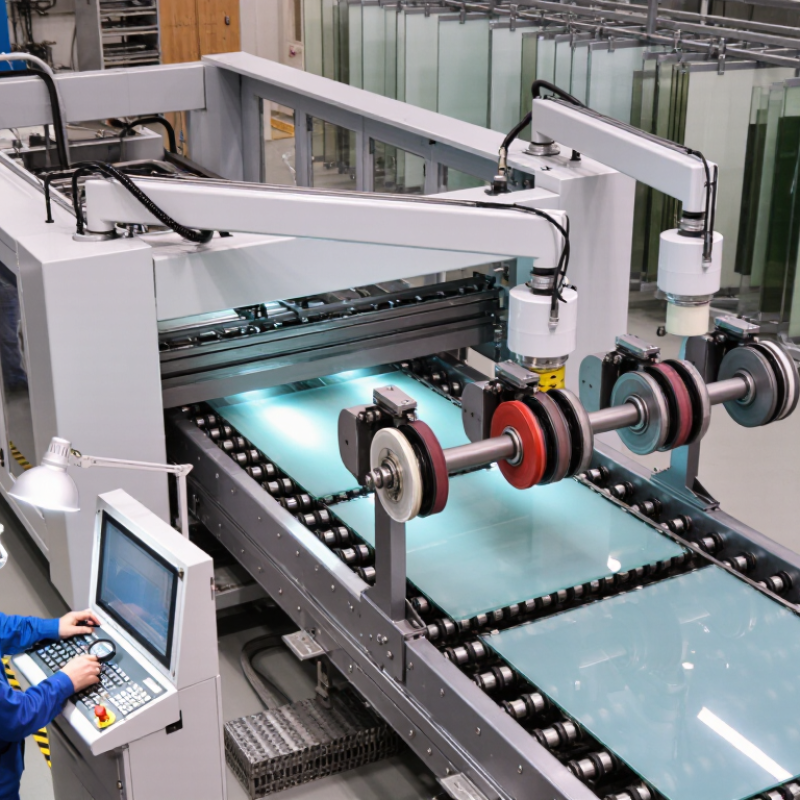
A glass chamfering machine grinds a sloped edge along a pane, reducing sharp corners and creating a consistent finish. The chamfer’s angle and width affect both appearance and fit. The goal is controlled. Unlike simple edge arrising, chamfering removes more glass, so stable support and accurate settings matter.
These machines are used for furniture panels, mirrors, shower screens, display cases, and architectural glazing. A narrow chamfer may soften the edge of a cabinet door, while a wider bevel can add a visible decorative border. Workpiece size, glass thickness, edge shape, and daily production volume all influence machine choice. A machine suited to flat panels may not handle irregular shapes efficiently.
Grinding wheels, feed speed, alignment, and water cooling affect the finished edge. Poor wheel condition can leave chips or uneven lines, especially noticeable under bright light. Automation can improve repeatability, but it cannot compensate for incorrect setup or inconsistent glass. Still, more automation is not always better; a smaller operation may value flexible adjustments over maximum throughput. Test pieces reveal details that a specification sheet may miss. Inspect the edge under direct light, and note whether its width stays consistent from corner to corner.
Choosing a glass chamfering machine in 2026 starts with the glass, not the machine. Identify whether you process clear, tinted, coated, laminated, or other specialty glass. Coatings can affect which face contacts a wheel, while laminated sheets may need careful support. Confirm the required machining sequence with your glass processor, especially for glass that will be tempered later. Tempered glass should not be chamfered after tempering. Small details matter.
Measure the full range of sheet thicknesses and sizes you expect to run. A machine that handles a narrow production range may struggle with occasional oversized panels. Specify the chamfer width, angle, and edge finish, then compare them with the machine’s adjustment range and wheel configuration. Also consider how operators load and support each sheet. A missed corner or inconsistent bevel can mean wasted material. It is easy to focus on maximum speed and overlook setup time; that trade-off deserves a closer look.
Tips: Bring sample glass and a drawing with dimensions to the machine evaluation. Ask for a trial on your actual material, including any coating or laminate. Check chamfer consistency at corners, inspect the finished edge under good lighting, and confirm coolant and maintenance requirements. Record the settings. They may need adjustment between glass types.
How to Choose a Glass Chamfering Machine in 2026?
Machine configuration should match the glass range, edge profile, and daily workload. A 2024 market assessment by Grand View Research expects steady growth in global flat glass demand through 2030. That trend favors flexible equipment, not simply larger equipment. A straight-line machine suits repeated rectangular panels. A shaped-edge system offers better versatility but demands stronger programming and operator training. Automatic loading can reduce handling damage, although it increases maintenance points.
Accuracy depends on more than the advertised tolerance. Check spindle stability, guide rigidity, coolant control, and wheel compensation. For thin architectural glass, vibration may create small edge chips that appear only after tempering. Ask suppliers for measured results, not sample photographs. ISO 9001 supports process control, but it does not guarantee a specific chamfer tolerance. The buyer must define it.
A practical trial matters.
Request test pieces close to production size. Measure chamfer width at several positions, then repeat after continuous operation. Reports from the International Energy Agency identify industrial energy efficiency as a major competitiveness factor, so inspect motor power, idle consumption, and coolant recycling. I have seen machines perform accurately for ten minutes, then drift as wheels heat. That weakness is easy to miss. Operator access, error logs, and spare-part availability deserve the same attention as cutting speed. A fast machine with unstable accuracy creates expensive rework.
| Machine Configuration | Typical Glass Thickness | Chamfer Angle Range | Typical Chamfer Width | Processing Speed | Typical Dimensional Accuracy | Automation and Control | Cooling and Abrasive System | Best-Suited Applications | Main Selection Considerations |
|---|---|---|---|---|---|---|---|---|---|
| Manual or Compact Single-Spindle Chamfering Machine | Approximately 3–12 mm | 0°–45° | 2–20 mm | Approximately 0.5–3 m/min | Typically ±0.3–0.5 mm, depending on operator setup and glass condition | Manual positioning with basic speed and angle adjustment; limited recipe storage | Water-fed diamond wheel; compact tank and basic filtration are common | Small workshops, repair work, low-volume decorative glass, and prototypes | Low initial investment and flexible use, but lower throughput and greater dependence on operator skill |
| Automatic Straight-Line Chamfering Machine | Approximately 3–25 mm | 3°–45° | 3–35 mm | Approximately 1–6 m/min | Typically ±0.2–0.3 mm for stable production conditions | Conveyor feeding, automatic glass alignment, digital parameter setting, and recipe storage | Multiple water-cooled diamond wheels with recirculation and settling filtration | Furniture glass, shower panels, architectural glass, and regular batch production | A practical general-purpose option; check conveyor stability, wheel adjustment, and maximum glass size |
| Double-Sided or Bilateral Chamfering Line | Approximately 4–25 mm | 3°–45° | 3–35 mm per side | Approximately 2–8 m/min | Typically ±0.15–0.25 mm after correct calibration | Continuous feeding with synchronized left and right processing; often includes automatic width adjustment | Independent water circuits or zoned cooling for multiple grinding stations | High-volume production requiring matched and parallel chamfers on opposite edges | High productivity and consistent symmetry, but requires more floor space, maintenance, and setup control |
| CNC Glass Chamfering and Edge-Processing Center | Approximately 3–25 mm, depending on spindle and tooling configuration | 0°–45° or wider with specialized tooling | 1–40 mm, depending on tool diameter and process | Approximately 0.5–8 m/min; cutting conditions vary by glass type and finish | Typically ±0.1–0.2 mm for programmed dimensions under controlled conditions | CNC interpolation, touchscreen or industrial controller, CAD/CAM compatibility, barcode or job-file input | Programmable water delivery, diamond tooling, and filtration sized for continuous grinding | Complex shapes, small-to-medium batches, custom architectural panels, and high-value workpieces | Best for flexibility and repeatability; requires skilled programming, tooling management, and preventive maintenance |
| Multi-Head Precision Chamfering Line | Approximately 4–30 mm, subject to machine design | 3°–45° | 3–45 mm | Approximately 3–10 m/min | Typically ±0.1–0.2 mm when glass support and calibration are well controlled | Automatic loading options, multi-stage grinding and polishing, digital monitoring, and production recipes | Several water-cooled grinding and polishing stations with centralized filtration | Large-scale architectural, solar, appliance, and furniture-glass production | High output and stable surface quality; verify line length, utility consumption, changeover time, and service access |
Capacity should match your real production pattern, not an optimistic sales forecast.
Measure daily glass volume, common thicknesses, edge angles, and peak orders. A machine rated for maximum output may perform poorly with frequent size changes. Measure real demand.
Ask for sample trials using your own glass, especially coated, laminated, or fragile pieces. Observe feeding stability, chamfer consistency, and operator adjustments. These details reveal more than a brochure.
Safety requires practical observation.
Check guarding around wheels, clear emergency stops, stable material support, and effective dust or water control. Fine glass particles can affect breathing, visibility, and nearby equipment. Operators should access cleaning points without reaching into hazardous areas. Training records and inspection routines also matter. A technically safe machine can become unsafe through rushed work.
Downtime hurts. Maintenance should be simple enough for daily use.
Inspect belts, bearings, coolant lines, abrasive wheels, and sensors at defined intervals. Confirm that replacement parts are available locally or within a predictable delivery time. Ask how long common repairs usually take.
Operating cost includes electricity, water, abrasives, labor, rejects, and lost production.
Compare these costs over several years, not only the purchase price. A lower-priced machine may consume more abrasive material or require frequent alignment. Calculate cost per finished edge from test data.
Forecasts remain imperfect. Real workshop dust, changing staff, and irregular orders will alter results. Leave room for these uncertainties, and record actual consumption after installation. A monthly review can expose costs that initial calculations missed.
Choosing a glass chamfering machine in 2026 starts with your actual production profile, not a feature list. Measure daily output, glass thickness, edge angle, and the smallest panel size. A workshop processing 6 mm shower panels needs different capacity from an architectural line handling laminated units. Write down peak demand, too. Average volume can hide costly Monday morning bottlenecks. In my experience, operators often underestimate setup time. That mistake affects labor more than advertised polishing speed.
Compare spindle power, abrasive compatibility, cooling, and waste control against those measurements. Ask for test results using your own glass, especially low-iron, laminated, or coated sheets. A clean chamfer should have consistent width, minimal chipping, and no visible thermal marks. Inspect the conveyor carefully. Can it hold a wet, heavy panel without edge movement? Check adjustment ranges, guarding, emergency stops, and access for routine cleaning. Safety and repeatability matter more than theoretical speed.
For a reliable purchase, calculate total operating cost over several years. Include abrasives, water treatment, electricity, replacement parts, training, and planned downtime. Request documentation for tolerances, maintenance intervals, and acceptance testing. Speak with technicians who will use the machine daily. Their objections may reveal awkward controls or difficult filter changes. I would leave capacity headroom, but not too much; unused power becomes wasted capital. This balance is easy to misjudge. A short production trial can expose that weakness before installation.
By continuing to browse or by clicking “Accept All Cookies,” you agree to the storing of first- and third-party cookies on your device to enhance site navigation, analyze site usage, and assist in our marketing efforts. View our Privacy and Cookie Policy.