
How to Choose the Right Steel Fittings for Global Sourcing?
Global sourcing of steel fittings is not simply a price exercise. It is a control problem involving metallurgy, dimensions, documentation, logistics, and supplier capability. The World Steel Association’s 2024 Short Range Outlook projected global steel demand at roughly 1.75 billion metric tons, showing the scale of the supply network behind industrial components. Yet, fittings steel is not interchangeable by appearance. A seamless elbow and a welded elbow may look similar, while their pressure performance, heat treatment, and inspection records differ significantly.
Reliable selection begins with the service conditions. Define the fluid, design pressure, operating temperature, corrosion exposure, connection type, and required wall thickness. Then match the specification with recognized standards, such as ASME B16.9 for factory-made wrought buttwelding fittings or ASTM A234 for carbon and alloy steel fittings. These standards support consistent dimensions and material requirements. They do not replace engineering review. That distinction is often missed.
Supplier verification should include mill test certificates, heat numbers, chemical analysis, mechanical results, and traceability from billet to finished fitting. ISO 9001 certification can indicate controlled processes, but certification alone proves little about every shipment. The IEA reports that iron and steel production contributes around 8% of global energy-related and process CO2 emissions, making material efficiency and responsible sourcing increasingly important. Buyers should therefore request production origin, recycled-content information, and realistic delivery evidence. Not every low-cost offer is efficient. Some are merely incomplete.
A practical sourcing decision balances compliance, lifecycle cost, inspection access, and supplier experience. Samples should be checked physically, not only reviewed in spreadsheets. Small details matter. A missing heat number can become a major project risk. Industry data offers direction, but site conditions and supplier behavior still require careful judgment.
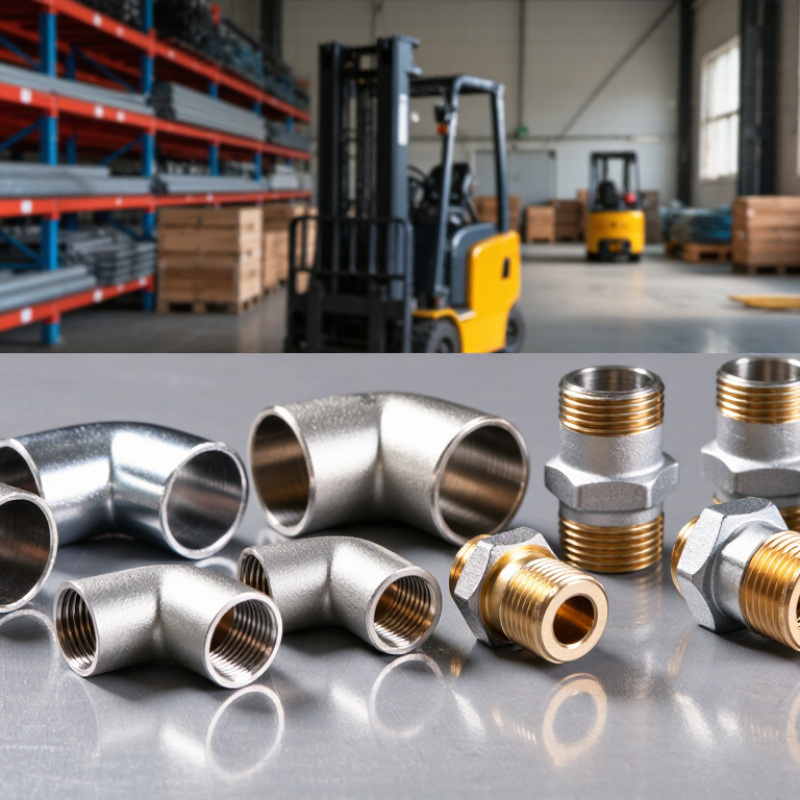
Define the Application: Pressure, Temperature, Size, and ASME B16.9 Dimensions
Choosing steel fittings starts with service conditions, not a catalog screenshot. Record fluid, design pressure, operating temperature, corrosion exposure, and cyclic loading. An experienced buyer checks maximum and minimum values. Not averages. World Steel Association’s World Steel in Figures 2024 reported global crude steel output of about 1.9 billion tonnes in 2023. However, large supply does not guarantee suitable fittings. Material certificates, heat numbers, impact-test requirements, and traceability still matter. For steam, sour service, or low-temperature duty, confirm chemistry and toughness against project specifications and applicable codes.
Size selection must cover outside diameter, wall thickness, center-to-end dimensions, and connection type. ASME B16.9 defines dimensions and tolerances for factory-made wrought butt-welding elbows, tees, reducers, caps, and returns. It does not replace design calculations or establish every pressure limit. Match the fitting with the pipe schedule and verify bore alignment at the weld. Check long-radius and short-radius elbows where pressure loss or pigging matters. Temperature changes can alter allowable stress, so pressure-temperature limits need separate confirmation. Request dimensional inspection records and required NDE reports. I once treated a nominal-size match as sufficient. It was not. A 12-inch label can hide schedule, radius, and wall-thickness differences. Recheck the approved drawing, mill certificate, markings, and packing list before shipment.
How to Choose the Right Steel Fittings for Global Sourcing? - Define the Application: Pressure, Temperature, Size, and ASME B16.9 Dimensions
| Selection Dimension | Required Application Data | Practical Sourcing Guidance | Illustrative Example |
|---|---|---|---|
| Fluid or service | Fluid composition, concentration, toxicity, cleanliness, and corrosion potential | Select a compatible material specification and confirm whether sour-service, sanitary, oxygen-clean, or other special requirements apply. | Carbon steel for a non-corrosive utility-water line; austenitic stainless steel for a chloride-containing process stream, subject to corrosion review. |
| Design pressure | Normal pressure, maximum design pressure, test pressure, vacuum condition, and pressure cycling | Do not select a fitting by nominal size alone. Confirm the allowable pressure using the applicable piping code, material allowable stress, wall thickness, temperature, joint efficiency, and corrosion allowance. | Design pressure: 25 bar at 150 °C. The final allowable pressure must be calculated under the governing design code. |
| Design temperature | Minimum, normal, maximum, upset, and cyclic temperatures | Check material strength reduction at elevated temperature, impact toughness at low temperature, thermal expansion, and any code-specific temperature limits. | Operating range: −20 °C to 180 °C. Confirm low-temperature impact requirements and high-temperature allowable stress before ordering. |
| Nominal pipe size | NPS or DN, pipe outside diameter, schedule or wall thickness | Use NPS with the corresponding outside diameter. NPS and DN are nominal designations and are not interchangeable without dimensional verification. | NPS 4 corresponds to an outside diameter of 114.3 mm; DN 100 is commonly used as the metric designation. |
| Fitting type | Elbow angle, tee or reducer arrangement, cap, cross, outlet configuration, and flow direction | Choose long-radius elbows where lower pressure drop is preferred; use short-radius elbows only when layout constraints and the piping code permit them. | NPS 6, 90-degree long-radius butt-welding elbow for a process header with limited allowable pressure loss. |
| Wall thickness or schedule | Pipe schedule, nominal wall, corrosion allowance, erosion allowance, and mill tolerance | Match the fitting end preparation and nominal wall to the mating pipe. Pipe schedule references commonly come from ASME B36.10M or ASME B36.19M, while fitting dimensions are covered by ASME B16.9. | NPS 4 Schedule 40 carbon-steel pipe has a nominal wall of 6.02 mm; verify the fitting wall and transition details on the drawing. |
| End preparation | Butt-welding bevel, root face, end squareness, and compatibility with the pipe bevel | Specify the required end preparation and confirm that the fitting is suitable for the selected welding procedure and wall thickness. | ASME B16.9 butt-welding fitting with end preparation suitable for a qualified piping weld procedure. |
| Material and corrosion allowance | Base material, product specification, heat treatment, corrosion allowance, and service environment | Common material specifications include ASTM A234 WPB for carbon-steel wrought fittings and ASTM A403 WP304/WP316 grades for wrought stainless-steel fittings, subject to project requirements. | ASTM A234 WPB, normalized or heat-treated as required by the specification, with a project-defined corrosion allowance. |
| Inspection and documentation | Material test report, heat number, dimensional inspection, NDE, PMI, hardness, impact testing, and certificates | Define inspection levels before purchase. Require traceability from the fitting to the material heat and request dimensional records for critical services. | EN 10204 Type 3.1 material certificate, visual and dimensional inspection, and radiographic or ultrasonic examination when required by the purchase specification. |
| Applicable standards | Dimensional standard, material standard, design code, testing requirements, and destination-market requirements | ASME B16.9 covers factory-made wrought butt-welding fitting dimensions, tolerances, and related dimensional requirements; it does not by itself establish a universal pressure rating for every fitting. | ASME B16.9 dimensions, ASTM A234 material, ASME B36.10M pipe schedule, and ASME B31.3 process-piping design, where applicable. |
Reference Dimensions for Common ASME B16.9 Long-Radius 90-Degree Elbows
| Nominal Size | Outside Diameter | Approx. Long-Radius Center-to-End Dimension | Typical Pipe Wall Reference | Sourcing Check |
|---|---|---|---|---|
| NPS 2 / DN 50 | 60.3 mm | 76.2 mm | Schedule 40: 3.91 mm | Confirm schedule, end bevel, actual wall, and dimensional tolerance. |
| NPS 4 / DN 100 | 114.3 mm | 152.4 mm | Schedule 40: 6.02 mm | Ensure the fitting is dimensionally compatible with the mating pipe and welding procedure. |
| NPS 6 / DN 150 | 168.3 mm | 228.6 mm | Schedule 40: 7.11 mm | Check center-to-end dimension, ovality, wall-thickness transition, and inspection requirements. |
| NPS 8 / DN 200 | 219.1 mm | 304.8 mm | Schedule 40: 8.18 mm | Verify layout clearance, pipe schedule, material grade, and code-based pressure design. |
Note: The dimensions shown are commonly used reference values for ASME B16.9 long-radius elbows and standard pipe schedules. Final procurement data should be confirmed against the current edition of the applicable standard, approved drawings, material specification, and governing piping design code.
Related Posts
-
7 Essential Insights about Steel Fittings for Optimal Performance
-
Exploring Fittings Steel Market Growth at the 138th Canton Fair in 2025 with Key Industry Insights
-

Top Steel Fittings Types You Need to Know in 2026?
-
Top 5 Essential Steel Fittings: Maximizing Durability and Performance in Industrial Applications
-
Top 10 Essential Tubing Fittings for Your Next Project
-

How to Choose the Right Steel Fittings for Your Project?