
China Top 10 High Mast Street Light Manufacturers?
Choosing a reliable High Mast Street Light manufacturer in China requires more than comparing product photos or export claims. This guide introduces ten notable manufacturers through practical, verifiable criteria. It considers engineering experience, production capability, quality systems, and after-sales support. The review also examines pole heights, LED lumen packages, wind-load calculations, hot-dip galvanizing, IP and IK protection, smart-control compatibility, and warranty terms. These details matter when a lighting system must illuminate highways, ports, stadiums, industrial parks, or large intersections.
The word “top” should be treated carefully. Market position changes, and supplier information is not always equally complete. Therefore, this list is a research starting point, not an unquestionable verdict. Company visits, sample inspections, laboratory reports, and project references can reveal more than a polished website. Field reality differs. A manufacturer may offer strong pricing but limited customization, while another may provide excellent engineering support at a higher cost. Buyers should request photometric files, structural calculations, installation guidance, and clear maintenance procedures before making a decision. Attention should also be given to driver quality, surge protection, corrosion resistance, spare-part availability, and delivery consistency. Small omissions can become expensive problems later. This article aims to provide a balanced, experience-informed comparison for importers, contractors, consultants, and municipal project teams. It recognizes that no supplier is perfect, and some evidence may require further verification. Careful evaluation remains essential when selecting a Chinese partner for a safe, durable, and efficient High Mast Street Light project.
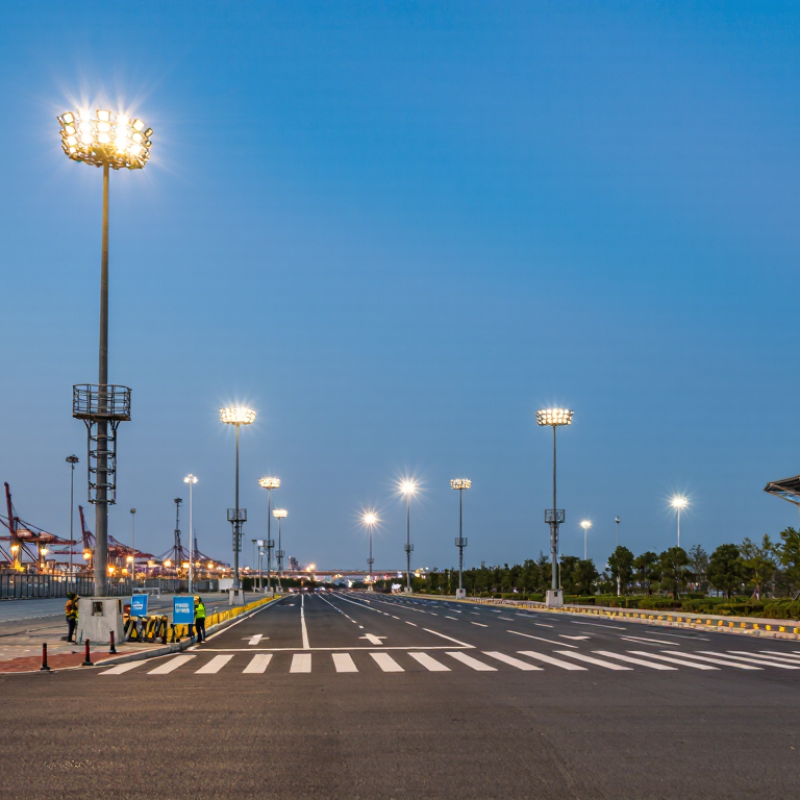
High Mast Street Lighting in China: Definition, Uses, and Key Features
High mast street lighting in China generally uses poles 15 to 40 meters high, with several luminaires mounted on a crown. It serves highways, ports, airports, industrial parks, large intersections, and logistics yards. China’s National Bureau of Statistics reported a 67.00% urbanization rate at the end of 2024. This continued urban growth increases demand for safer, wider-area outdoor lighting.
Scale changes everything. High mast systems can illuminate large spaces with fewer foundations and reduced roadside obstruction. The U.S. Department of Energy reports that LED systems can reduce lighting energy use by 50% or more compared with conventional technologies. Key features include high-efficiency LED modules, surge protection, corrosion-resistant poles, remote monitoring, and motorized lowering systems. These systems simplify maintenance when luminaires reach considerable heights.
Good design depends on more than wattage. Engineers should verify illuminance, uniformity, glare control, wind loading, drainage, and emergency access under local standards. The CIE 115 framework remains a useful reference for road-lighting performance and visual comfort. A common field mistake is selecting fixtures before studying pole spacing and mounting height. It looks efficient on paper. It may create dark zones. Maintenance records, photometric simulations, and measured nighttime readings provide stronger evidence than catalog claims. Real projects also need practical checks for lifting equipment, cable routing, and seasonal weather exposure.
China Top 10 High Mast Street Light Manufacturers? - High Mast Street Lighting in China: Definition, Uses, and Key Features
| No. | Evaluation Dimension | Typical Reference Data | Why It Matters | Common Application |
|---|---|---|---|---|
| 1 | Definition and Mounting Height | High mast lighting generally uses poles about 15–40 m high with one or more luminaires mounted near the top. | A greater mounting height can cover a wider area and reduce the number of poles required. | Expressways, ports, airports, logistics yards, and large public spaces. |
| 2 | LED System Efficacy | Modern outdoor LED systems commonly provide approximately 120–180 lm/W at the system level, depending on design and operating conditions. | Higher efficacy can lower electricity consumption while maintaining the required illuminance. | Energy-conscious municipal and industrial lighting projects. |
| 3 | Rated Power Range | Typical LED high mast installations use approximately 240–1,200 W per pole, subject to pole height, layout, and lighting requirements. | Power selection affects coverage, energy cost, glare, and compliance with the lighting design. | Road interchanges, container terminals, stadium surroundings, and open yards. |
| 4 | Ingress Protection | IP65 or IP66 is commonly specified for outdoor LED luminaires; the exact rating should be verified in the product documentation. | Protection against dust and water helps support reliable operation in exposed environments. | Coastal areas, rainy regions, dusty industrial sites, and open-air facilities. |
| 5 | Mechanical Impact Resistance | IK08 or higher is often selected for outdoor luminaires where resistance to mechanical impact is required. | A stronger housing can reduce the risk of damage during service, weather events, or nearby operations. | Transport hubs, construction zones, warehouses, and industrial compounds. |
| 6 | Color Temperature | Common choices range from 3,000 K to 5,700 K; warmer light may be preferred near residential areas. | Color temperature influences visual comfort, atmosphere, visibility, and potential light impact on nearby communities. | Urban roads, industrial estates, ports, parking areas, and recreational spaces. |
| 7 | Optical Distribution | Narrow, medium, wide, and asymmetric beam distributions are used according to the area geometry and pole arrangement. | Correct optics improve uniformity and help limit wasted light, glare, and excessive spill light. | Linear highways, circular plazas, rectangular yards, and irregular open areas. |
| 8 | Control and Dimming | Common control options include photocells, time schedules, 0–10 V dimming, DALI, and wireless monitoring systems. | Controls can adjust output to traffic patterns and support fault monitoring and energy management. | Smart-city roads, campuses, ports, industrial parks, and managed parking facilities. |
| 9 | Structural and Wind Design | Pole thickness, foundation, luminaire area, and wind speed must be calculated for the specific project location; there is no universal pole specification. | Proper structural design is essential for safety, stability, and long-term service performance. | Coastal zones, typhoon-prone areas, elevated sites, and exposed highways. |
| 10 | Maintenance and Serviceability | Typical features include lowering mechanisms, modular LED compartments, surge protection, replaceable drivers, and accessible inspection points. | Convenient maintenance can reduce service time, equipment downtime, and lifecycle operating costs. | Large sites where mobile elevating equipment or frequent manual access is costly. |
Note: The figures above are typical planning references rather than universal specifications. Final selection should be based on a photometric design, local lighting standards, environmental conditions, structural calculations, and project-specific energy requirements.