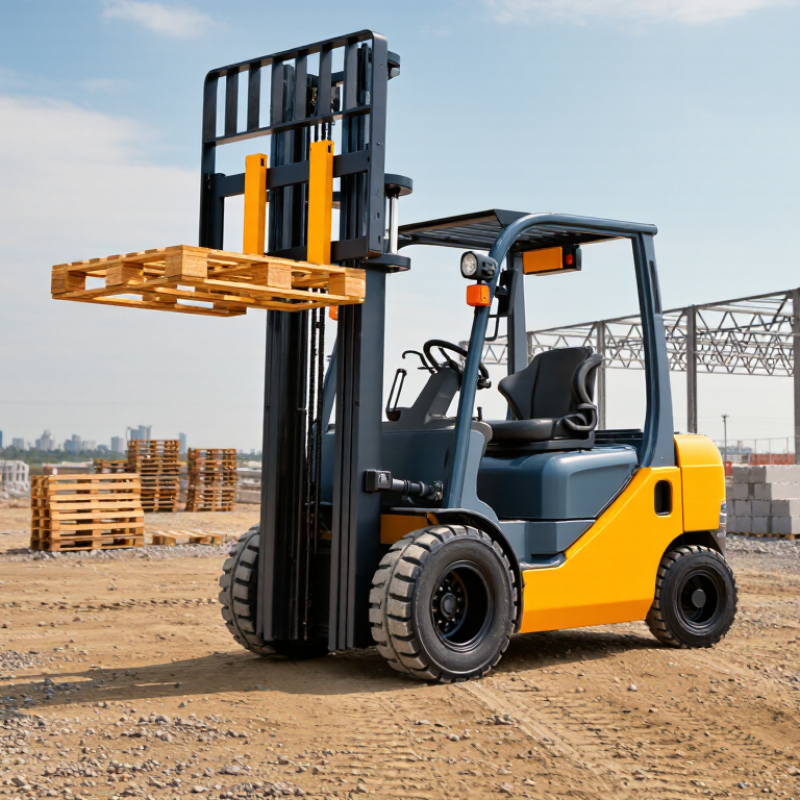
Choosing the best 4 wheel drive forklift for sale requires more than comparing prices and lifting capacities. A rough yard, wet loading area, or uneven construction site can quickly expose a weak drivetrain. In contrast, a smooth warehouse floor may not justify four-wheel drive. The right choice depends on application, not appearance.
Recent World Industrial Truck Statistics reports show global industrial-truck shipments remaining above two million units annually. This strong demand reflects continued investment in logistics, manufacturing, ports, and construction. China remains a major production center, offering diesel, LPG, electric, and hybrid forklift models. However, production volume does not automatically prove reliability. Buyers should verify load charts, service records, component origins, and independent quality certifications.
A practical evaluation begins with the working surface. Pneumatic tires suit gravel and outdoor yards. Solid tires may perform better around sharp debris. A 3,000-kilogram forklift sounds capable, but its rated capacity changes with lift height, load center, and mast configuration. Check those details carefully. OSHA guidance identifies struck-by and crushing hazards as major forklift risks, while ISO 5053-1 provides internationally recognized terminology for industrial trucks. These references support safer purchasing decisions.
This guide compares Chinese four-wheel-drive forklifts through performance, safety, durability, operator comfort, fuel use, and after-sales support. It also examines warranty clarity and spare-parts availability. A low purchase price can become expensive when downtime reaches several days. That risk is easy to underestimate. No single model suits every site, and even an experienced buyer can overlook local terrain or maintenance conditions. The most dependable choice balances verified specifications with real operating experience.
Best China 4 wheel drive forklift for sale?
When comparing a 2–5 t four-wheel-drive forklift, capacity is only the starting point. ISO 5053-1:2020 provides standard terminology for powered industrial trucks, but it does not make every 2 t forklift the same. Rated capacity depends on load center, mast height, attachments, and ground conditions. A 2,500 kg rating may fall sharply when a long load is lifted high.
Check the data plate carefully.
Four-wheel drive improves traction on gravel, mud, ramps, and uneven yards. It does not replace correct tire selection or operator training. The World Industrial Truck Statistics report recorded about 2.1 million industrial truck shipments worldwide in 2023, showing strong demand but also a crowded equipment market. Buyers should compare tested performance, not just advertised tonnage. Ask for brake-test records, axle specifications, turning radius, and a cold-start inspection. Small details matter.
A practical site test is valuable. Drive across a wet slope with the intended load, then measure steering response and stopping distance. That test may expose weaknesses brochures hide. Fuel use, hydraulic leakage, and visibility around the mast also affect operating cost. I would not choose a machine solely because it says “4WD.” The phrase sounds reassuring, but it can oversimplify real traction needs. Confirm the actual rated capacity at your load center, service support, parts availability, and conformity documentation before purchase.
Best China 4 Wheel Drive Forklift for Sale?
For a China four-wheel-drive forklift, power choice should follow the duty cycle, not showroom power. Diesel suits muddy yards, ramps, and long shifts. An experienced operator may achieve 8–10 working hours from a full tank, although heavy attachments reduce runtime. Noise and exhaust still matter. The U.S. Environmental Protection Agency lists diesel combustion at approximately 10.2 kilograms of CO2 per U.S. gallon.
LPG offers cleaner indoor handling than diesel, with quick refueling between shifts. Practical runtime often reaches 6–8 hours, depending on cylinder size and idling. The U.S. Department of Energy’s Alternative Fuels Data Center gives propane a combustion factor near 5.75 kilograms of CO2 per gallon. LPG reduces some visible soot, but ventilation remains essential. I would not call it emission-free.
Electric models produce no tailpipe emissions and work quietly around warehouses, food storage, and residential construction areas. A properly sized battery can support roughly 6–8 hours, while fast charging or battery swapping may extend availability. Charging losses and cold weather complicate that estimate. EPA’s eGRID2022 report shows an average U.S. grid intensity of about 0.37 kilograms of CO2 per kilowatt-hour, with major regional differences. A low-emission grid improves the electric case; a coal-heavy grid weakens it. Runtime claims need real load tests.
Choosing the best China 4 wheel drive forklift for sale requires more than checking engine output. On uneven yards, lift height, gradeability, turning radius, and ground clearance determine daily productivity. A practical evaluation starts with the rated load, not the maximum lifting figure. A 3,000 kg forklift may lift that load only at a specified load center and limited height. Ask for test data. Check the capacity chart.
Lift height should match your rack beams, containers, or loading platforms. Mast stability matters near full extension. Gradeability indicates the slope a loaded machine can climb under stated conditions. It is not a promise for every wet ramp. Tire type, payload, surface grip, and speed change the result. A 25 percent grade equals roughly 14 degrees, but operators still need controlled speed and clear visibility. Ground clearance protects the underside across gravel, drainage channels, and broken concrete. More clearance helps, though it can raise the center of gravity.
Turning Radius deserves a real-site measurement. A compact radius saves space, yet a long wheelbase may improve stability and ride comfort. Compare the outside turning radius with your narrowest aisle, then leave room for the load. During inspection, drive a loaded unit over the route and measure stopping distance, steering response, and tire scrub. I would also verify hydraulic response after repeated cycles. Small delays matter. Published figures can look precise, but field conditions rarely are. Request service records, capacity charts, independent inspection, and clear warranty terms before purchase.
Best China 4 Wheel Drive Forklift for Sale?
Choosing a four-wheel-drive forklift requires more than checking lifting capacity and price. On site, uneven ground quickly exposes weak steering, poor braking, or an unstable mast. I have seen buyers focus on engine power and overlook basic safety details. That mistake becomes expensive.
Ask the supplier for test records related to GB/T 5144-2008 and ISO 3691-1. These standards guide important safety requirements, including stability, controls, visibility, and protective systems. Confirm the exact edition and application with a qualified inspection professional. The mast should rise smoothly, hold its load, and show no twisting under rated weight. Check welds, hydraulic hoses, carriage locking points, and overhead protection. A strong-looking mast is not always a safe mast.
Tips: Test the forklift on the actual working surface. Drive across gravel, ramps, and tight corners. Watch for frame shaking, delayed braking, or sudden hydraulic movement. Measure the operator’s sightline with a raised pallet. Seat restraints, a clear dashboard, warning alarms, and a properly guarded overhead area deserve close attention. Small details matter. I would also request maintenance intervals, load charts, and operator training records before purchase. Some evaluations are imperfect because warehouse conditions change daily, so leave room for a second site test.
| Evaluation Dimension | Practical Data or Benchmark | Safety and Selection Check | Priority |
|---|---|---|---|
| Applicable Safety Standards | GB/T 5144-2008 addresses safety requirements for powered industrial trucks. ISO 3691-1 specifies safety requirements and verification for self-propelled industrial trucks within its stated scope. | Request the current conformity documentation, risk assessment, operating instructions, and inspection records. Confirm that the truck configuration and intended application fall within the applicable standard scope. | Required |
| Rated Load Capacity | Common 4-wheel rough-terrain and industrial configurations are often offered in approximately 2,000–5,000 kg capacity classes; the actual rating depends on the load center, mast, attachments, and configuration. | Check the data plate and load chart. Never select capacity from the nominal model class alone; verify the rated capacity at the actual load center and lift height. | Required |
| Load Center | Typical rated-load centers for many counterbalanced forklifts are around 500–600 mm, but the value varies by design and capacity class. | Measure the real load depth and compare it with the truck’s rated load center. A longer or uneven load can reduce allowable capacity and longitudinal stability. | Required |
| 4-Wheel-Drive System | Four-wheel drive can improve traction on compacted gravel, construction sites, ramps, and uneven outdoor surfaces. It does not automatically increase rated lifting capacity. | Check axle rating, differential or axle protection, ground clearance, tire type, turning radius, braking performance, and the manufacturer’s approved surface conditions. | Recommended for Outdoor Use |
| Operating Surface and Grade | Safe gradeability is application-specific and depends on load, direction of travel, surface condition, tire selection, and braking capacity. No single grade value applies to every forklift. | Use the supplier’s verified gradeability chart. Travel with the load uphill where required by the operating instructions, reduce speed, and avoid loose edges, potholes, and unstable shoulders. | Required |
| Mast Configuration | Common options include duplex and triplex masts. A triplex mast provides greater lift height with lower collapsed height, while a duplex mast generally has fewer moving stages and simpler visibility characteristics. | Compare free lift, collapsed height, maximum lift height, mast deflection, visibility through the mast, and the required overhead clearance at the worksite. | Required |
| Mast and Fork Inspection | Critical components include mast channels, rollers, lift chains, chain anchors, hydraulic cylinders, hoses, fork heels, fork shanks, and locking mechanisms. | Look for cracks, bending, corrosion, stretched or damaged chains, hydraulic leaks, unequal chain tension, worn fork heels, and missing fork-retaining devices. | Required |
| Fork Dimensions | Fork length and cross-section must match the load and carriage rating. Longer forks may reduce effective capacity when the load center moves forward. | Verify fork markings, fork spacing, locking pins, heel condition, and the required fork length for pallets or non-palletized loads. Do not use cracked or excessively worn forks. | Required |
| Overhead Guard | A properly designed overhead guard helps protect the operator from falling objects within its intended protection limits. It is not designed to support an elevated load. | Check guard mounting, welds, roof mesh or bars, deformation, clearance, and compatibility with the mast and attachments. Do not remove or modify the guard without approved engineering documentation. | Required |
| Operator Restraint | A functioning seat belt or approved operator restraint helps keep the operator within the protected zone during tip-over or sudden movement. | Inspect the belt, buckle, anchor points, seat switch, and interlock system. The truck should not be operated with a damaged, bypassed, or nonfunctional restraint. | Required |
| Operator Visibility | Visibility can be affected by mast stages, load height, fork carriage width, attachments, lighting, and rear counterweight design. | Conduct a route-specific visibility trial with the intended load. Provide mirrors, lighting, warning systems, a spotter, or a controlled travel procedure where direct visibility is restricted. | Required |
| Braking and Parking | The service brake must provide controlled stopping, while the parking brake must hold the unloaded or loaded truck as specified by the approved design and operating instructions. | Test service and parking brakes before each shift. Check brake fluid or air-system condition where applicable, tire grip, pedal response, and parking-brake holding performance. | Required |
| Steering and Stability | Counterbalanced forklifts steer from the rear, producing a tail-swing hazard. Stability is influenced by load center, lift height, speed, turning radius, slope, and surface conditions. | Check steering free play, axle condition, turning response, stability controls, and the rated capacity chart. Keep the load low during travel and avoid sudden turns with an elevated load. | Required |
| Tires and Wheels | Pneumatic tires are generally suited to rougher outdoor surfaces; solid or cushion tires are commonly used where puncture resistance and firm floors are more important. | Match tire type and ply rating to the surface and load. Inspect pressure, tread, cuts, sidewall damage, wheel nuts, rim condition, and equal tire size on the axle. | Required |
| Hydraulic System | The hydraulic system controls lifting, tilting, and attachment functions. Leakage or uncontrolled drift can create crushing and dropped-load hazards. | Check hoses, fittings, cylinders, control valves, oil level, mast drift, tilt-hold function, and hose routing. Use only compatible hydraulic oil and approved replacement components. | Required |
| Warning and Lighting Equipment | Typical equipment may include headlights, rear work lights, brake lights, audible horn, reversing alarm, beacon, and pedestrian-warning systems. | Select equipment according to traffic density, noise level, visibility, and local workplace rules. Test all warning devices at the start of each shift. | Recommended |
| Emergency Isolation and Controls | Controls should be clearly identified and protected against unintended activation. Emergency isolation arrangements depend on the truck’s power system and design. | Verify ignition or power isolation, neutral-start function, control labeling, emergency procedures, and safe shutdown instructions. Do not bypass interlocks. | Required |
| Attachments | Side shifters, clamps, rotators, extensions, and other attachments change the load center and may reduce residual capacity. | Confirm attachment rating, locking method, hydraulic compatibility, visibility, load-chart adjustment, and compatibility with the carriage and forks. | Required |
| Noise, Exhaust, and Ventilation | Internal-combustion trucks can produce exhaust emissions and heat. Indoor use requires suitable ventilation and compliance with workplace exposure controls. | Assess fuel type, emission controls, exhaust routing, noise, ventilation, fire precautions, and whether an electric or lower-emission configuration is more suitable. | Application Dependent |
| Pre-Shift Inspection | A documented inspection should cover tires, forks, mast, chains, hydraulics, steering, brakes, restraint, horn, lights, alarms, leaks, and visible structural damage. | Remove the truck from service when a safety-critical defect is found. Repairs should be completed and recorded by competent personnel before returning the truck to operation. | Required |
| Operator Competence | Operators require site-specific training covering controls, load handling, stability, pedestrian interaction, ramps, attachments, charging or fueling, and emergency response. | Use authorized operators only. Maintain training, evaluation, refresher, and authorization records in accordance with applicable workplace requirements. | Required |
Selecting a China-made four-wheel-drive forklift requires more than comparing purchase prices. Calculate total cost of ownership across five years. Include fuel or electricity, tires, scheduled service, downtime, operator training, and resale value. A cheaper unit may become expensive after repeated hydraulic or axle repairs.
In a 2023 report, the International Energy Agency noted that energy prices strongly influence industrial equipment operating costs. The lesson is practical. Request real consumption data under your load conditions.
Warranty wording deserves close inspection. Ask for coverage periods, excluded components, labor terms, and response times. Confirm whether the supplier keeps filters, seals, transmission parts, and drive-axle components in regional stock. Record the promised delivery time in the contract. “Available” is not enough.
A 2022 Deloitte supply-chain survey found that disruption remains a major operational risk for manufacturers. I would also request three service references from similar working environments.
Load-test records are essential. Each document should show the forklift serial number, rated load, load center, test weight, test date, inspector, and photographs. Check alignment with ISO 5057 inspection practices and local requirements.
OSHA estimates that forklifts cause about 85 workplace fatalities and 34,900 serious injuries annually in the United States. That figure deserves respect. A certificate without traceable evidence proves little. I have seen neat spreadsheets hide missing test details. That is a warning. Verify the records independently before payment.
By continuing to browse or by clicking “Accept All Cookies,” you agree to the storing of first- and third-party cookies on your device to enhance site navigation, analyze site usage, and assist in our marketing efforts. View our Privacy and Cookie Policy.