
10 Best Brewery Fittings Suppliers for Global Buyers?
Choosing the right brewery fittings supplier can affect hygiene, production speed, and long-term maintenance. Global buyers need more than attractive catalog prices. They need dependable materials, accurate dimensions, and responsive technical support.
This guide examines ten suppliers serving international brewing operations. It considers stainless steel quality, tri-clamp compatibility, valve performance, gasket selection, and weld consistency. Details matter. A poorly finished fitting can trap residue around a tank outlet. Suppliers are also compared through export experience, documentation, packaging standards, lead times, and after-sales communication. Certifications, pressure ratings, and surface finishes deserve careful verification before any purchase. Not every supplier uses the same terminology, and some published specifications remain unclear. That weakness should not be ignored.
The selected companies may suit craft breweries, beverage factories, pilot systems, and larger production plants. Their product ranges can include elbows, tees, reducers, sight glasses, butterfly valves, sampling valves, and hose connections. Buyers should match each component with cleaning temperatures, operating pressure, and process fluid requirements. Food-contact compliance also needs confirmation for the destination market. Experience suggests that small details often create the largest costs later. A cheap fitting may require repeated replacement. No supplier is perfect. Performance can vary between batches, regions, and distributors. This comparison therefore offers practical guidance, not an absolute verdict. Requesting samples, drawings, inspection records, and clear warranty terms remains sensible. Real purchasing decisions should combine this review with site-specific engineering advice.
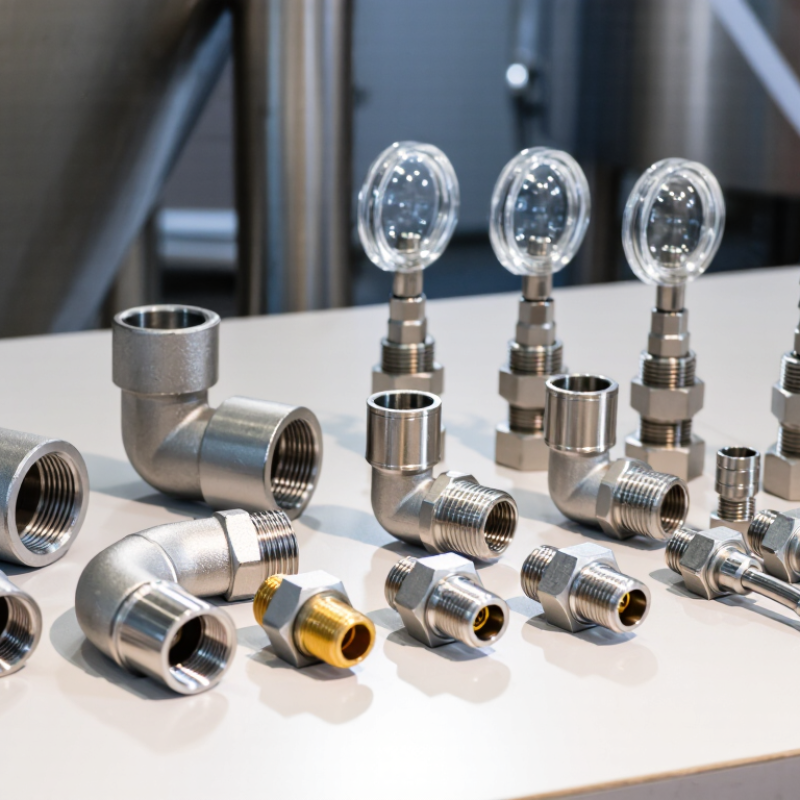
What Brewery Fittings Are and Why Global Breweries Need Them
Brewery fittings are the small sanitary components that connect tanks, pipes, pumps, filters, and filling equipment. They include tri-clamp connections, elbows, tees, reducers, valves, sight glasses, spray balls, and food-grade gaskets. Their job looks simple. It is not.
Every fitting must support hygienic flow, reliable cleaning, and stable pressure. Rough welds or poorly matched seals can trap yeast, water, or cleaning residue. That risk increases when breweries switch between ales, lagers, and non-alcoholic products. The Brewers Association reported that U.S. craft brewers produced about 23.1 million barrels in 2023, showing the scale of equipment used across modern production. Global buyers also face different pipe standards, temperatures, and service requirements. A fitting that fits one system may fail on another.
Market pressure makes selection more important. Grand View Research estimated the global beer market at about USD 793.7 billion in 2023, with continued growth expected through 2030. More production means more connections to inspect and replace. Stainless steel is common, but surface finish, gasket material, pressure rating, and internal geometry still matter. The weakest point is often the gasket. Cheap parts can become expensive through leaks, downtime, or repeated cleaning. I have seen specifications look complete while omitting drainability. That mistake deserves a second review. Suppliers should provide traceable material records, dimensional drawings, cleaning guidance, and clear tolerances before international shipment.
| Rank | Supplier Profile | Typical Product Strength | Common Material | Connection Standards | Typical Surface Finish | Typical Size Range | Typical Pressure Capability | Best-Fit Brewery Application | Key Global-Buying Advantage |
|---|---|---|---|---|---|---|---|---|---|
| 1 | Sanitary Stainless-Steel Specialist | Tri-clamp ferrules, elbows, tees, reducers and hygienic unions | 316L stainless steel for product-contact parts; 304 stainless steel for selected utility applications | Tri-clamp, DIN 11851, SMS and ISO-style sanitary connections | Internal Ra ≤ 0.8 µm is commonly available; electropolished options may be specified | DN10 to DN150; approximately 1/2 inch to 6 inches | Usually dependent on size, wall thickness and clamp design; commonly suitable for low- to medium-pressure process lines | Brewhouse transfer, wort lines, bright-beer tanks and cellar piping | Broadest range of standard hygienic components and easy replacement worldwide |
| 2 | Hygienic Valve and Fitting Supplier | Butterfly valves, check valves, sample valves and compatible fittings | 316L wetted body with FDA-compliant elastomer options such as EPDM or silicone | Tri-clamp, welded ends and threaded utility connections | Machined hygienic bore with crevice-minimizing geometry | DN15 to DN100; approximately 1/2 inch to 4 inches | Commonly rated for process pressures around 6 to 10 bar, subject to model and temperature | Tank isolation, product routing, CIP flow control and sampling points | Combines fittings with flow-control equipment, reducing interface and compatibility risks |
| 3 | Custom Fabrication and Weld-Fitting Supplier | Custom elbows, offset spools, manifolds, dip tubes and welded assemblies | 316L stainless steel with full material traceability available on request | Butt-weld, orbital-weld preparation and sanitary clamp ends | Internal polishing commonly specified from Ra 0.8 µm down to Ra 0.4 µm | DN15 to DN200; larger sizes may be engineered to order | Designed according to pipe schedule, weld quality and operating conditions | Compact breweries, process skids and difficult-to-route cellar systems | Reduces dead legs and field welding when accurate drawings and measurements are supplied |
| 4 | Small-Brewery Standard Parts Supplier | Ready-to-ship clamps, gaskets, hose tails, elbows and tees | 304 or 316L stainless steel; food-contact elastomers selected by application | Tri-clamp and common hose-barb configurations | Commercial sanitary finish suitable for general brewery service | 1/2 inch to 3 inches | Typically used for low-pressure transfer, hose and cleaning connections | Taprooms, pilot systems, mobile breweries and maintenance inventories | Low minimum order quantities and fast replenishment of frequently lost or worn parts |
| 5 | Large-Plant Process Piping Supplier | High-volume fittings, hygienic reducers, long-radius bends and pipe assemblies | 316L stainless steel with documented heat and batch records | DIN, ISO, ASME-style sanitary and welded process connections | Controlled internal finish with passivation documentation available | DN25 to DN300; approximately 1 inch to 12 inches | Selected according to piping class, temperature, fluid density and engineering code | High-throughput breweries, fermentation halls and distribution plants | Supports standardized bills of materials and repeat purchasing across multiple sites |
| 6 | CIP-Focused Fittings Supplier | Spray-device connections, return-line fittings, hygienic valves and drainable components | 316L stainless steel with chemically resistant gasket materials | Tri-clamp, welded and hygienic threaded connections | Low-crevice surfaces designed to support cleaning-in-place performance | DN15 to DN150 | Suitable rating depends on cleaning temperature, chemical concentration and line design | Caustic, acid, sanitizer and rinse circuits | Helps reduce product retention, cleaning shadows and contamination risks |
| 7 | Gasket and Seal Specialist | Clamp gaskets, valve seals, seat rings and replacement sealing kits | EPDM, silicone, PTFE and other application-specific elastomers | Compatible with tri-clamp, DIN, SMS and selected threaded sanitary fittings | Manufactured with smooth, non-porous contact surfaces | Commonly 1/2 inch to 6 inches | Determined by elastomer, temperature, compression and fitting geometry | Beer, wort, hot water, steam-adjacent service and chemical cleaning | Improves uptime by providing correctly matched replacement seals and materials |
| 8 | Export-Oriented Multi-Standard Supplier | Mixed inventory covering several regional sanitary standards | 304 and 316L stainless steel, with documented elastomer choices | Tri-clamp, DIN 11851, SMS, RJT and ISO-style options | Standard hygienic finish with optional polishing and passivation | DN10 to DN200 | Varies by connection standard, size and component type | Breweries operating across different countries or expanding imported equipment | Reduces conversion problems when equipment from multiple regions must be connected |
| 9 | Instrumentation and Sampling Fittings Supplier | Pressure-gauge adapters, temperature ports, sample valves and sight fittings | 316L stainless steel for wetted components; glass or polymer windows where suitable | Tri-clamp, hygienic threaded and welded instrument ports | Polished internal passages with minimized product-holding areas | 1/2 inch to 2 inches for most instrument connections | Selected according to instrument range and process pressure | Fermentation monitoring, carbonation checks, bright-beer transfer and quality control | Supports process visibility without introducing unnecessary contamination points |
| 10 | Rapid-Replacement and Maintenance Supplier | Standard elbows, clamps, ferrules, gaskets, hose fittings and repair kits | 304 or 316L stainless steel; food-grade elastomers for sealing components | Common tri-clamp and hose-interface sizes | Commercial sanitary finish for routine brewery maintenance | 1/2 inch to 4 inches | Generally intended for standard low- to medium-pressure brewery service | Emergency repairs, planned shutdowns and preventive-maintenance programs | Useful for keeping critical spare parts locally available and minimizing downtime |
Related Posts
-
Essential Tips for Choosing the Right Brewery Fittings for Your Brewing Setup
-
What is Brewery Fittings and Why Are They Essential for Craft Beer Production
-
Top 10 Essential Brewery Fittings Every Brewer Should Consider
-

Exploring the Best Brewery Fittings in China for Craft Beer Production?
-
Best Brewery Fittings for 2026 Top Quality Global Purchases?
-
Top 10 Stainless Steel Fittings Every Global Buyer Must Know