
2026 Best Airport Flood Lights for Global Buyers
Choosing the 2026 Best Airport Flood Lights for Global Buyers requires more than comparing wattage or advertised brightness. Airport lighting must support safe aircraft movement, ground handling, maintenance work, and reliable visibility during rain, dust, and low temperatures. Airport Flood Lights should deliver controlled illumination across aprons, taxiway edges, cargo areas, and service roads without creating distracting glare for pilots or ground crews.
Real-world performance often differs from catalog claims. A 1,000-watt fixture may appear powerful, yet poor beam control can leave dark patches beneath a 20-meter mast. Experienced buyers should examine photometric files, mounting height, beam angles, color consistency, surge protection, thermal management, and maintenance access. IP66 protection may suit exposed locations, but local conditions still require careful validation.
Small details matter.
A coastal airport may need stronger corrosion resistance. A cold-region site may demand reliable starting at sub-zero temperatures. Smart controls can reduce energy use, but complex systems may increase training and repair needs. That trade-off deserves honest review. No single model is best for every airport, and this guide avoids pretending otherwise. It compares practical specifications, installation experiences, supplier reliability, warranty support, and regional certification requirements. Testing sample fixtures at the actual apron remains valuable, even when laboratory data looks convincing. Global buyers can then select lighting that performs consistently, supports safer operations, and remains serviceable long after installation.
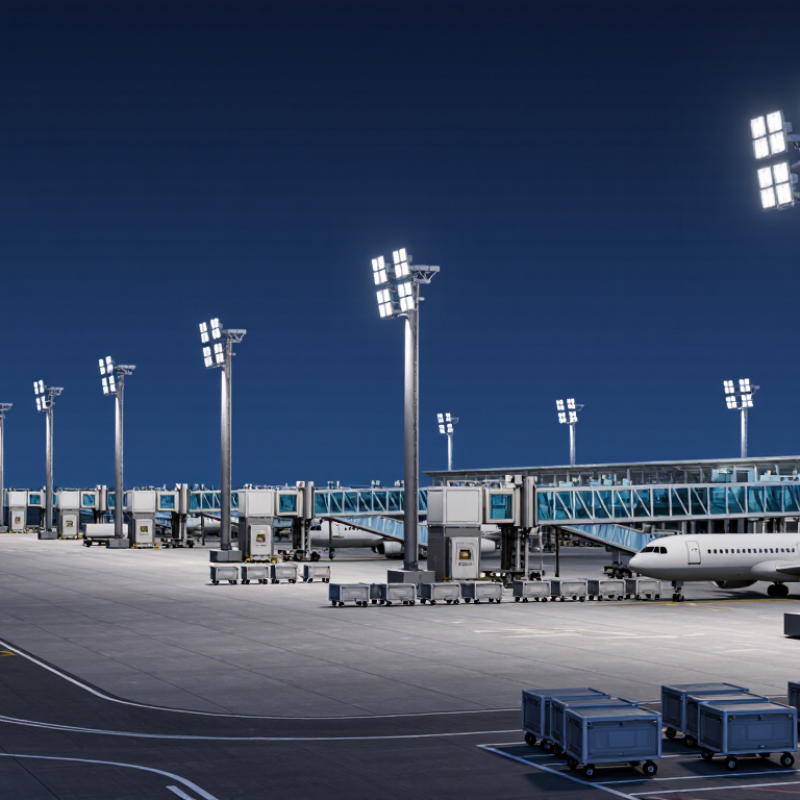
Airport Flood Light Basics: ICAO Annex 14’s 20-Lux Apron Benchmark
Airport flood lights are not chosen by wattage alone. For global buyers, the practical starting point is ICAO Annex 14. For aircraft stands, its commonly referenced benchmark is 20 lux of maintained average horizontal illuminance. This level supports safer marshalling, equipment checks, and visible markings during night operations. Maintained matters. It means the target should remain after dirt, lamp ageing, and expected output loss. An initial reading of 20 lux may later become inadequate. That detail is easy to miss.
Site assessment should follow the aircraft stand layout, not a catalog photograph. Measure a grid across parking positions, service lanes, and areas near the fuselage. Record horizontal readings at working height and inspect glare from pilot approaches. Sharp contrast can hide wheel chocks, cables, or ground staff. Uniformity deserves equal attention. Bright pools beside dark zones create operational hesitation. LED floodlights can help, but optics, mounting height, aiming, and control settings decide performance. Energy savings also depend on dimming schedules and real occupancy patterns. Local aviation authorities may apply stricter requirements than the ICAO reference. Verify current national rules before purchase. From field work, we have learned that calculations often look cleaner than reality. Rain, aircraft shadows, and temporary equipment can change the result. That is why commissioning tests and nighttime observation remain necessary.
2026 Best Airport Flood Lights for Global Buyers - Airport Flood Light Basics: ICAO Annex 14’s 20-Lux Apron Benchmark
| Evaluation Dimension | Recommended / Reference Value | Why It Matters for Airport Buyers | Applicable Reference or Note |
|---|---|---|---|
| Apron average horizontal illuminance | 20 lux minimum benchmark for aircraft stand areas | Supports aircraft servicing, ground handling, loading, inspection, and safe vehicle movement during night operations. | ICAO Annex 14, Volume I, apron floodlighting provisions; verify the current edition and the applicable national aviation rules. |
| 20-lux unit conversion | Approximately 1.86 foot-candles | Useful when comparing tender documents that use SI units and imperial units. | 1 foot-candle = 10.764 lux; 20 lux ÷ 10.764 = 1.86 foot-candles. |
| Average-to-minimum uniformity | Maximum ratio of 4:1 for aircraft stand areas | Limits dark patches and excessive contrast that can affect personnel visibility and ground operations. | ICAO apron floodlighting recommendation; the project lighting calculation should demonstrate compliance. |
| Illuminance measurement plane | Horizontal plane at the apron or aircraft stand surface | Provides a consistent basis for photometric calculations, acceptance testing, and maintenance checks. | Use a defined measurement grid and calibrated lux meter during commissioning. |
| Light source technology | LED floodlight with photometric files for project calculation | LED systems can provide directional optics, instant switching, dimming, and lower maintenance than many legacy discharge systems. | Performance must be verified from LM-79 or equivalent photometric test data and the submitted IES/LDT file. |
| Typical correlated color temperature | 3,000–5,000 K, selected by the airport lighting designer | Affects visual comfort, color recognition, glare perception, and compatibility with surrounding airport lighting. | CCT is a project choice, not a universal ICAO apron requirement; evaluate glare, wildlife, and local environmental rules. |
| Color rendering | CRI typically ≥70 for general outdoor industrial lighting; higher values may be specified | Improves recognition of equipment, safety markings, cables, fluid leaks, and aircraft surface conditions. | Confirm the required CRI in the airport’s technical specification; it is not a substitute for illuminance and uniformity compliance. |
| Glare and stray-light control | Use asymmetric optics, shielding, aiming limits, and controlled tilt | Reduces discomfort glare and unwanted light toward pilots, control towers, adjacent roads, and neighboring properties. | Confirm compatibility with aerodrome safeguarding, obstacle limitation, and local light-pollution requirements. |
| Ingress protection | IP66 minimum is commonly specified for exposed airport floodlight housings | Protects the enclosure against dust and powerful water jets in demanding outdoor environments. | Verify the rating through an independent test report; IP ratings do not define impact, corrosion, or wind resistance. |
| Impact protection | IK08 or IK10 where the risk assessment requires enhanced mechanical protection | Helps protect luminaires from accidental contact, maintenance activity, and airport service-vehicle exposure. | Select the IK level according to site risk and confirm compliance with IEC 62262 test classifications. |
| Operating temperature | Specify the actual site range; many outdoor products are rated around −40°C to +50°C | Ensures reliable starting, thermal management, and driver performance in cold, hot, or desert climates. | The stated range is a common procurement target, not a universal requirement; check the product data sheet. |
| Surge protection | Specify a site-appropriate combination of internal and external surge protection | Reduces damage from switching events and lightning-related surges on long outdoor cable runs. | The required test level depends on the electrical design, earthing system, exposure, and local standards. |
| Commissioning evidence | Provide lux-grid measurements, aiming records, as-built drawings, and maintenance instructions | Creates an auditable record that the installed floodlighting achieves the approved design values. | Acceptance criteria should be agreed before installation and checked against the current airport authority requirements. |
Note: The 20-lux value is an apron aircraft-stand planning benchmark associated with ICAO Annex 14 guidance. Final lighting levels, uniformity, glare limits, equipment ratings, and certification requirements must be confirmed against the current ICAO edition, national regulations, airport operator specifications, and the site-specific lighting design.